
Form 8283 instructions, line by line
Form 8283 is the IRS form for noncash charitable gifts. File it when your deduction for all donated property is more than $500 for the year. Section A covers items, or groups of similar items, worth $5,000 or less: nearly every clothing and household donation. Section B, with a qualified appraisal, is for anything above $5,000.
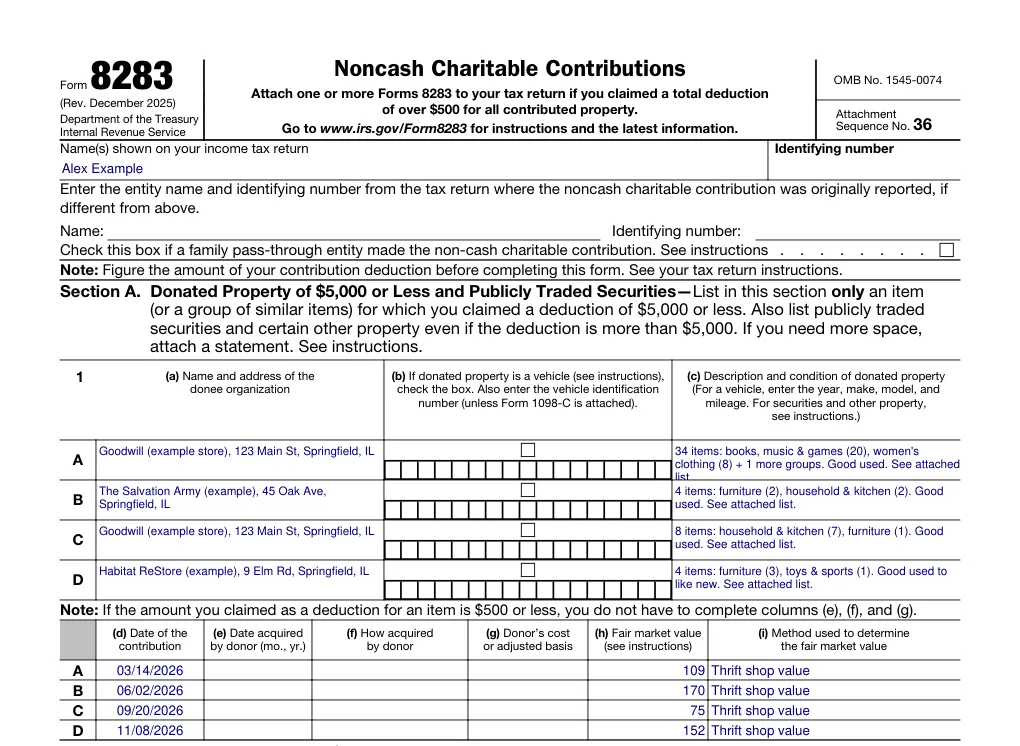
Below: which section you need, what goes in each column of Section A, a filled example made by this tool, and a short guide to Section B. Log your drop-offs in the tool and it fills Section A for you.
Rules for tax years 2025 and 2026 · Last reviewed · Not tax advice
Can I still deduct it? 2026 rules checkItemizing, the new 0.5% AGI floor and the cash-only deduction for non-itemizers
1. Drop-off details
2. Add items
3. Your donation log
| Item | Condition | Qty | Each | Total | Remove |
|---|
No items yet. Pick a category and item above and press “Add to drop-off”.
Saved on this device only (your browser’s storage). Export a backup file if you switch devices or clear your browser.
4. Tax packet: Form 8283 + itemized list
IRS Form 8283 Section A filled in from your log (charity, date, description, fair market value, method), plus an itemized list to attach, and a CSV for TurboTax, H&R Block or your preparer.
One-time $9.99 for tax year : Form 8283 Section A filled in and still fillable, the itemized list, no watermark. No account, no subscription.
Secure checkout by Stripe. Full refund within 14 days, no questions asked. Your log stays on this device; only the payment goes to Stripe.
Not tax advice. Value ranges are estimates compiled from published charity valuation guides; you are responsible for the values you claim. Rules from IRS Publications 526 and 561. Not affiliated with Goodwill Industries, The Salvation Army, Intuit or the IRS.
Section A or Section B?
| What you gave | Section | Extra paperwork |
|---|---|---|
| Clothing, household goods or furniture, $5,000 or less per item or group of similar items | A | None beyond your receipts and itemized list |
| An item or group of similar items worth more than $5,000 | B | Qualified appraisal; the charity signs Part V |
| A clothing or household item not in good used condition, claimed at more than $500 | B | Qualified appraisal, attached to your return |
| Publicly traded stock or mutual fund shares, any amount | A | None |
| Car, boat or airplane claimed at more than $500 | A or B | Form 1098-C from the charity |
Similar items are added together for the $5,000 test even if you gave them to different charities: “consider all items in the group, even if items in the group were donated to more than one donee organization” (Form 8283 instructions).
The top of page 1
- Name(s) shown on your income tax return: exactly as on Form 1040.
- Identifying number: your Social Security number. Write it in yourself; this tool never asks for it.
- The pass-through entity lines (name, identifying number, checkbox) are only for gifts made by a partnership or S corporation that you are reporting from a Schedule K-1. Leave them blank for your own donations.
Section A, line 1: column by column
| Column | What to enter | Example |
|---|---|---|
| (a) Name and address of the donee organization | The charity and the store or pickup address. | Goodwill (example store), 123 Main St, Springfield, IL |
| (b) Vehicle box and VIN | Only for vehicles. Leave blank for goods. | blank |
| (c) Description and condition | “Describe the property in sufficient detail”: the more it is worth, the more detail. Add the condition. | 34 items: books, music & games (20), women’s clothing (8) + 1 more group. Good used. See attached list. |
| (d) Date of the contribution | The day you dropped it off. One row per date. | 03/14/2026 |
| (e) Date acquired by donor (mo., yr.) | Only if the row is over $500. “Various” is accepted for a group bought at different times and held at least 12 months. | blank (row is $109) |
| (f) How acquired by donor | Only if the row is over $500: purchase, gift, inheritance or exchange. | blank |
| (g) Donor’s cost or adjusted basis | Only if the row is over $500: roughly what you paid. Keep records that support it. | blank |
| (h) Fair market value | The value on the date you gave it: for used goods, the thrift-store price. | 109 |
| (i) Method used to determine the fair market value | For used clothing and household goods: “Thrift shop value”. Others: “Comparable sales”, “Catalog”, “Appraisal”. | Thrift shop value |
The form has four rows (A–D). With more than four drop-offs, attach another Form 8283 page; the IRS instructions allow more than one form.
Section B in brief (over $5,000)
- Part I: get a written qualified appraisal first. Line 2 asks for the type of property; “Clothing and household items” has its own box. Line 3 lists the description, physical condition, appraised value, date and way you acquired it and your cost.
- Part II: only if you gave a partial interest or attached restrictions on how the charity can use the property.
- Part III: your statement for any item in the group appraised at $500 or less.
- Part IV: the appraiser’s declaration and signature. The fee cannot be a percentage of the appraised value.
- Part V: the charity’s acknowledgment, signed by an official authorized to sign its tax returns. This is where the charity’s EIN goes.
Mistakes that get Form 8283 questioned
- “3 bags of clothes” as the description. List the kinds of items and attach an itemized list.
- One row for a whole year of drop-offs on different dates. Use one row per contribution date.
- Column (i) left blank. Write the method, usually “Thrift shop value”.
- Original purchase prices in column (h). Fair market value is what the item would sell for used.
- Stained, torn or broken items counted at full value. They count for nothing unless an appraisal supports a value over $500.
- No written acknowledgment for a drop-off worth $250 or more. Ask for a receipt that describes the items.
Where Form 8283 goes
Attach it to Form 1040 with Schedule A. Tax software (TurboTax, H&R Block, FreeTaxUSA) builds Form 8283 from the noncash donations you enter and e-files it with your return, so many people use this page to check what the software asks for. If you file on paper, attach the form and the itemized list.
If you take the standard deduction, donated goods are not deductible and you do not need Form 8283.
Frequently asked questions
When do I need Form 8283?
When your total deduction for all donated property (not cash) is more than $500 for the year. Section A covers items or groups of similar items worth $5,000 or less, which includes nearly all clothing and household donations. Over $5,000 for one item or a group of similar items needs a qualified appraisal and Section B.
Do I need Form 8283 if my donations were under $500?
No. The form is required when your total deduction for noncash gifts is more than $500 for the year. Below that, keep your receipts and itemized list with your records.
Does the charity need to sign Section A?
No. Only Section B has a donee acknowledgment (Part V) that the charity signs. For Section A you need your own records and, for any single drop-off of $250 or more, the charity’s written acknowledgment.
Which version of Form 8283 should I use?
The current form and instructions are the December 2025 revision (checked November 17, 2026). Download the form from irs.gov/Form8283 or let your tax software produce it; our packet uses the IRS PDF unchanged.
What do I write in “How acquired” and “Date acquired” for old clothes?
You only need those columns for a row worth more than $500. For a group of household goods bought over the years, “Various” for the date and “Purchase” for how acquired are common entries, with your approximate cost in column (g).
Do I need a receipt from the charity?
Keep a receipt (or reliable written record) for every drop-off. For any single contribution worth $250 or more you need a written acknowledgment from the charity, received before you file, that describes the items and says whether you got anything in return. Unattended drop boxes do not give you one, so ask at the counter for larger donations.
Where is my donation log stored?
Only in your own browser on this device. There is no account and the log is never sent to our server. Use “Export backup” to keep a copy or move it to another device, and “Import” to load it back.
Sources
- IRS Instructions for Form 8283 (Rev. December 2025)
- IRS Form 8283 (Rev. December 2025), PDF
- IRS Publication 561, Determining the Value of Donated Property
- IRS Publication 526, Charitable Contributions
- IRS Form 8283 and instructions
- IRS: tax inflation adjustments for 2026 (standard deduction)
- Value ranges: The Salvation Army donation value guide (satruck.org)
- Value ranges: Goodwill Northern New England donation value guide
- Value ranges: Easterseals-Goodwill Northern Rocky Mountain
- Value ranges: Goodwill Easterseals Miami Valley (2020 brochure) and Goodwill Industries International valuation guide
This site gives general information, not tax, legal or accounting advice. Tax rules change and depend on your situation; ask a tax professional before you file. We are not affiliated with Goodwill Industries, The Salvation Army, Intuit or the IRS; their names are used only to describe the guides and products people search for.